
12 July 2026
Why Profile Optimisation Improves Interview Shortlists
Interview shortlists are rarely decided by experience alone. Profile optimisation helps mid and senior professionals make their value clearer, align with hiring criteria and reduce the risk signals that stop strong candidates reaching interview.

If you are applying for roles that genuinely match your experience but you are still not hearing back, the problem may not be your capability. It may be the way your capability is being signalled.
Interview shortlists are built under time pressure. Recruiters and hiring managers are not reading your career history as a biography. They are scanning for evidence that you can solve a specific hiring problem, operate at the required level, and represent a low-risk interview choice.
That is why profile optimisation matters. For mid-level and senior professionals, it is not about making a CV look prettier or adding fashionable phrases. It is about aligning your CV, resume, LinkedIn profile, and career positioning so that your relevance is immediately clear to both applicant tracking systems and human decision-makers.
The shortlist is a risk-reduction exercise
A shortlist is not a ranking of the most impressive careers in the market. It is a practical hiring filter. Before inviting someone to interview, an employer wants to know whether the candidate appears to match the role, has operated in similar conditions, can communicate their value clearly, and is worth the time of a busy interview panel.
This is especially important in competitive hiring markets. The CIPD regularly reports on resourcing and talent planning, including the ongoing challenge of attracting candidates with the right skills. When employers are trying to reduce uncertainty, a vague or unfocused profile can make even a strong candidate look like a maybe rather than a yes.
Profile optimisation improves your shortlist chances because it reduces the amount of interpretation required. Instead of expecting a recruiter to connect scattered details across multiple roles, it presents a coherent case: this is the role I am targeting, this is the level I operate at, and this is the evidence that supports it.
What profile optimisation actually means
A well-optimised profile is not a keyword-stuffed document. It is a structured, recruiter-led positioning exercise. The aim is to make your profile more relevant, readable, searchable, and persuasive for the types of roles you want.
| Profile area | Unoptimised version | Optimised version |
|---|---|---|
| Opening profile | Generic summary of years of experience | Clear positioning linked to target roles, sector, level, and value |
| Role descriptions | Duties and responsibilities copied from job history | Achievement-led evidence showing outcomes, scale, and impact |
| Keywords | Missing, inconsistent, or overused | Naturally aligned with job descriptions and recruiter search behaviour |
| Format | Dense, decorative, or difficult to scan | Clean, ATS-friendly, and easy for a recruiter to navigate |
| Repeats job titles with little context | Reinforces the same professional proposition in a searchable format | |
| Career story | Leaves the reader to infer relevance | Builds a logical case for why you fit the target opportunity |
The most visible part of this work is often the CV profile at the top of your document. If that opening section is weak, the rest of the CV has to work harder. For a deeper breakdown of that specific section, Optima has a dedicated guide on how to write a CV profile that wins more interviews.
Why profile optimisation improves interview shortlists
It makes your value proposition obvious quickly
Recruiters often screen many applications for one vacancy. Even when they read carefully, their first pass is usually a fast relevance check. They are looking for a reason to keep reading.
A strong profile answers that question early. It tells the reader what kind of professional you are, the business problems you solve, the environments you understand, and the level at which you operate. For senior candidates, this is critical because broad experience can easily become unclear experience.
For example, a senior operations leader might have managed transformation, supplier performance, cost reduction, compliance, and team restructuring. If all of that is presented as a long list of responsibilities, the recruiter may miss the main value. Optimisation turns the list into a sharper proposition, such as operational transformation leadership across complex, multi-site environments.
It maps your experience to the hiring criteria
Most shortlisting decisions are made against a role specification. The recruiter may be checking for sector exposure, leadership scope, technical capability, commercial impact, regulatory knowledge, transformation experience, or stakeholder management.
If your CV does not use language that maps to those criteria, you risk looking less relevant than you are. This is where ATS compatibility and human readability overlap. Applicant tracking systems may parse your CV for role-related terms, but recruiters also use familiar language to decide whether your experience fits.
The point is not to copy a job description. It is to translate your experience into the language of the market. A finance leader who writes only about reporting duties may be overlooked for a role requiring commercial finance, business partnering, forecasting, and board-level insight, even if they have done all of those things.
It replaces claims with evidence
Many profiles rely on claims such as strategic leader, excellent communicator, commercially focused, or results-driven. These phrases are not harmful in isolation, but they rarely secure interviews by themselves. Recruiters need proof.
Optimisation strengthens the evidence behind the claim. It asks what changed because you were in the role. Did revenue improve, costs reduce, processes become more efficient, customers retain longer, risk decrease, teams stabilise, or systems improve?
A weak bullet might say: Responsible for leading the finance team and supporting senior stakeholders.
A stronger version would say: Led a 12-person finance team through a reporting transformation, improving month-end accuracy and giving senior stakeholders clearer commercial insight for decision-making.
The second version is more shortlist-friendly because it shows leadership scope, transformation context, team size, and business value. It gives the recruiter something concrete to take forward.
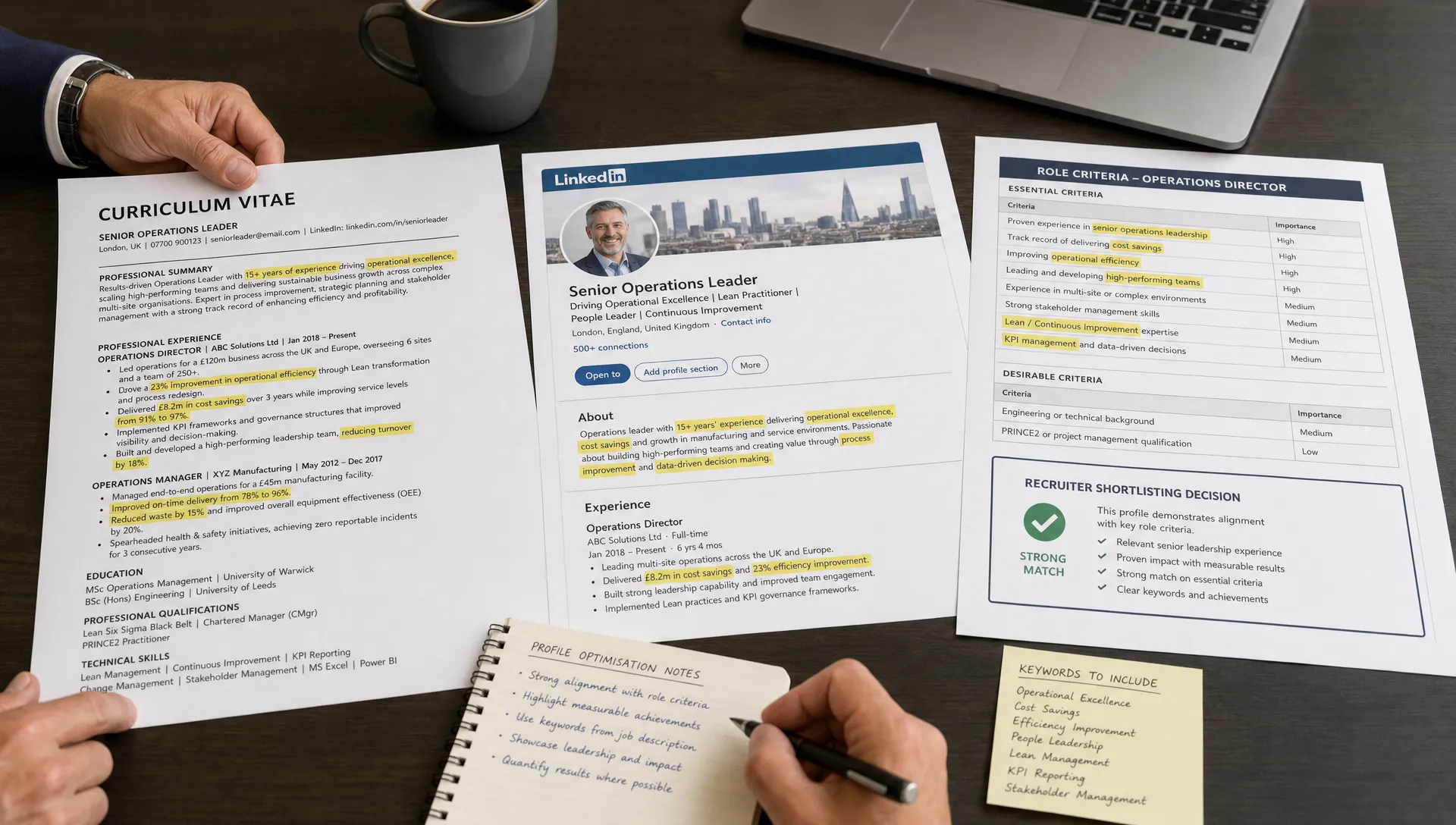
It improves consistency across CV, resume, and LinkedIn
Recruiters rarely look at your CV in isolation. They may check your LinkedIn profile, compare dates, review recommendations, or search for additional context. If your CV positions you for one type of role while LinkedIn suggests something different, it creates uncertainty.
Consistent positioning matters even more if you are changing direction, returning to the market after a break, moving countries, or stepping into a more senior role. Your LinkedIn headline, About section, experience summaries, and skills should reinforce the same message as your CV, while still being written in a platform-appropriate style. If you are repositioning into a new field, this guide to LinkedIn profile optimisation for career changers is a useful next step.
Why mid-level and senior professionals benefit most
Early-career CVs are often assessed mainly on qualifications, core skills, and potential. Mid-level and senior profiles are judged differently. Employers want to see judgement, leadership maturity, commercial awareness, stakeholder influence, and evidence of results in complex settings.
This creates a challenge. The more experienced you are, the more information you could include. Without optimisation, senior profiles often become too long, too dense, or too historical. They describe everything the person has done, rather than the parts that matter most for the next role.
| Seniority signal | Why recruiters look for it | How optimisation brings it out |
|---|---|---|
| Scale | Shows whether your background matches the size of the role | Adds team size, budget, region, revenue, portfolio, or operational scope where relevant |
| Impact | Shows whether your work changed business outcomes | Converts tasks into measurable achievements and business results |
| Leadership | Shows whether you can influence people and decisions | Highlights reporting lines, stakeholder groups, coaching, change leadership, and governance |
| Strategic judgement | Shows whether you can operate beyond delivery | Connects your actions to commercial, operational, or organisational priorities |
| Market relevance | Shows whether your experience fits current hiring needs | Aligns terminology with target sectors, role titles, and regional hiring standards |
This is why the same person can receive very different results from two versions of a CV. One version presents a career history. The other presents a hiring case.
Common reasons strong candidates miss the shortlist
A qualified candidate can miss out for reasons that have little to do with ability. The most common issue is lack of clarity. If your target role is not obvious, your profile may be interpreted too broadly. A recruiter may not know whether to consider you for operations, transformation, general management, consulting, or programme leadership.
Another issue is over-reliance on job titles. Titles vary widely across companies and countries. A Head of Operations in one organisation may have broader scope than a Director in another. A Vice President title in North America may not map cleanly to UK or European expectations. Profile optimisation adds the context needed to make your level clear.
A third issue is buried impact. Many experienced professionals place the strongest achievements halfway down the second page, hidden under routine responsibilities. Shortlisting improves when the most relevant proof appears early and is easy to scan.
Finally, some candidates use one generic CV for every application. This may feel efficient, but it often weakens relevance. You do not need to rewrite everything for each role, but your opening profile, key skills, and achievement emphasis should reflect the opportunity you are pursuing.
How to optimise your profile for shortlist decisions
The best optimisation work starts before writing. It begins with deciding what the profile is meant to achieve.
- Define your target role clearly: Identify the job titles, sectors, company types, and seniority levels you want to be considered for.
- Audit recent job descriptions: Look for repeated requirements, language, responsibilities, and outcomes across roles that interest you.
- Rewrite the opening profile around relevance: Lead with your professional identity, target value, strongest evidence, and market fit.
- Prioritise achievements over duties: Keep responsibilities concise and use more space for outcomes, scope, and measurable contribution.
- Check ATS readability: Avoid complex formatting, text boxes, graphics, and unusual section headings that may reduce parsing accuracy.
- Align LinkedIn with the CV: Make sure your headline, About section, experience, and skills support the same positioning.
- Review the profile like a recruiter: Ask whether the first page gives enough reason to shortlist you without needing extra explanation.
This process is not about pretending to be a different candidate. It is about removing the noise that prevents employers from seeing the candidate you already are.
What profile optimisation cannot do
It is important to be realistic. Profile optimisation cannot guarantee interviews. It cannot replace relevant experience, create qualifications you do not have, or overcome every market condition. It also cannot compensate for applying to roles that are far outside your evidence base.
What it can do is improve the probability that your profile is understood correctly. It can help you pass initial screening, present your value more persuasively, and give hiring teams clearer reasons to move you forward.
Once your profile begins to generate interviews, the next challenge is converting those opportunities. At that stage, structured preparation becomes essential, and this UK-focused guide on how to prepare for a job interview can help you turn shortlist success into stronger interview performance.
Frequently Asked Questions
Does profile optimisation guarantee more interviews? No. No CV, resume, or LinkedIn profile can guarantee interviews because hiring depends on market conditions, competition, timing, and role fit. Good optimisation improves your chances by making your relevance clearer and easier to assess.
Is profile optimisation the same as keyword stuffing? No. Keyword stuffing can make a profile sound unnatural and may weaken credibility. Effective optimisation uses relevant role language naturally, supported by evidence and context.
Should I optimise both my CV and LinkedIn profile? Yes, especially if you are applying for senior roles or being approached by recruiters. Your CV and LinkedIn profile should not be identical, but they should tell a consistent professional story.
How often should I update my profile? Review it whenever your target role changes, when you complete a major project, when you enter a new market, or when applications are not converting into interviews despite a strong fit.
Is profile optimisation useful for executive candidates? Yes. Executive and senior-level candidates often need sharper positioning because employers assess leadership scope, commercial impact, strategic judgement, and stakeholder influence, not just technical experience.
Turn strong experience into a stronger shortlist case
If your experience is strong but your applications are not converting, your profile may need clearer positioning rather than more applications. A recruiter-led review can identify what is helping, what is missing, and what may be causing hesitation during screening.
Optima Career Studio provides recruiter-led CV, resume, and LinkedIn profile optimisation for professionals across UK, European, and North American hiring markets, with support ranging from profile audits to executive-level career strategy. The goal is simple: help your profile make a clearer, stronger case for the interviews you are qualified to win.