
3 July 2026
How to Prepare for a Job Interview: The UK Professional Guide for 2026
Strong interviews are built before the meeting starts, especially for senior candidates and career changers. This guide shows UK professionals how to research, rehearse, handle virtual formats, and turn complex experience into confident answers in 2026.

Why Thorough Interview Preparation Is Essential in 2026
Strong job interview preparation in 2026 gives UK professionals a clear advantage by demonstrating deep research, relevant examples, and confident delivery that sets candidates apart.
Job interview preparation is the structured process of researching, rehearsing, and refining responses ahead of a formal meeting with a prospective employer. For mid-level and senior professionals, it is no longer enough to arrive with a strong CV and a general sense of the role. Interviewers increasingly expect evidence of commercial understanding, role-specific motivation, stakeholder awareness, and the ability to communicate impact clearly.
The 2026 hiring landscape also places greater pressure on authenticity. AI-assisted applications have made many CVs and cover letters sound more polished, but also more similar. Interview performance is where hiring teams test whether the person behind the profile can think with clarity, explain decisions, and handle challenge. For career changers, this matters even more because the interview must bridge the gap between past experience and future credibility.
What UK interviewers are assessing
UK employers typically assess four areas during interview: capability, motivation, fit, and risk. Capability is whether you can do the job. Motivation is whether you genuinely want this role, not just any role. Fit is how you work with others and adapt to the organisation. Risk is whether the hiring panel can trust your judgement, communication style, and likely performance after appointment.
Senior interviews often add another layer: strategic judgement. A hiring manager may ask about transformation, ambiguity, underperformance, cost pressure, regulatory change, or stakeholder conflict. The strongest candidates do not simply describe tasks. They explain the context, the trade-offs, the action taken, and the measurable or observable outcome.
Why preparation matters for career changers
Career changers need to translate value, not defend the move. Skills transfer is the process of identifying and applying professional competencies developed over time when adapting to new roles or industries. A finance leader moving into operations, a teacher moving into learning design, or an accountant moving into commercial analysis must show how decision-making, communication, compliance, analysis, and stakeholder management remain relevant in the new context.
If you are repositioning your professional story before interviews, it is worth aligning your spoken examples with how you present the transition on paper. Optima’s guide on how to explain a change in career on your CV is a useful companion because interview answers and CV positioning should reinforce each other.
Summary: Thorough preparation helps UK professionals convert experience into evidence, demonstrate credibility beyond the CV, and reduce perceived hiring risk. In 2026, the candidates who perform best are usually those who research with precision, rehearse with intention, and communicate their relevance in a calm, commercially aware way.
How to Research the Company and Role Effectively
Effective job interview preparation starts with targeted research into the company’s recent projects, values, challenges, and the specific requirements of the role.
Good research is not a memory test. It is the foundation for sharper answers, better questions, and more confident positioning. Your goal is to understand what the organisation is trying to achieve, where the role fits, and why your background is relevant to that agenda.
Start with the job description and separate it into outcomes, responsibilities, skills, and behaviours. Outcomes tell you what success will look like. Responsibilities show what you will own. Skills reveal the required technical or functional capability. Behaviours indicate how the organisation expects work to be delivered. This simple breakdown turns a broad vacancy into an interview preparation map.
Build a focused research file
For a UK professional interview, your research file should include the employer’s website, LinkedIn presence, leadership profiles, recent news, annual report if relevant, customer or client segments, competitors, and any sector-specific pressures. If the organisation is regulated, review the key regulatory context. If it is investor-backed, look for growth signals. If it is public sector or charity-based, study funding, governance, and stakeholder priorities.
Research should also be industry-specific. A candidate interviewing for an operations, property, or project delivery role, for example, could study how a project-led business such as Revo Craft Renovations positions its renovation services, process, and client outcomes before practising answers about quality, delivery risk, customer experience, and project coordination.
| Research area | What to look for | How to use it in the interview |
|---|---|---|
| Role requirements | Repeated skills, deliverables, systems, leadership scope | Match each priority to a relevant example from your background |
| Company direction | Recent launches, expansion, restructuring, transformation | Show awareness of where the organisation is heading |
| Market context | Competitors, customer expectations, regulation, cost pressure | Frame your answers around real business conditions |
| Culture and values | Stated behaviours, leadership tone, employee messaging | Adapt your examples without pretending to be someone you are not |
| Interview panel | Job titles, career history, functional responsibilities | Anticipate likely concerns and tailor your questions |
Prepare insight-led questions
Strong interview questions should prove that you have thought beyond the advert. Instead of asking only about working hours, benefits, or reporting lines, ask about success measures, strategic priorities, team dynamics, and the challenges the appointed person will inherit.
For senior roles, consider questions such as: what would make the first six months successful, what problem the role was created to solve, how decisions are made across functions, and what constraints the team is currently navigating. These questions position you as someone already thinking at the level of contribution, not simply selection.
Summary: Effective research connects the role, company, market, and panel into one coherent preparation strategy. By turning research into tailored examples and intelligent questions, you show the employer that your interest is specific, your thinking is commercial, and your experience is relevant to their immediate priorities.
How to Prepare and Practise Answers to Common Interview Questions
Job interview preparation requires developing concise, evidence-based answers using the STAR method while tailoring examples to the new role or industry.
The STAR method stands for Situation, Task, Action, and Result. It gives structure to competency and behavioural answers by helping you explain the context, your responsibility, what you did, and what changed because of your action. For senior professionals, the strongest STAR answers also include scale, complexity, stakeholders, constraints, and lessons learned.
Avoid preparing full scripts. Scripts often sound rehearsed and can collapse when the interviewer asks a follow-up question. Instead, build an answer bank of flexible examples. Each example should have a clear point, a strong result, and relevance to the target role.
Prepare for core question types
Most interviews include a blend of motivational, competency, behavioural, technical, and scenario-based questions. Career changers should also expect questions about why they are moving, whether they understand the new field, and how quickly they can become effective.
A practical answer bank might include examples of leadership, problem solving, stakeholder influence, conflict resolution, change delivery, commercial impact, resilience, and learning from failure. For each example, prepare a 60-second version and a deeper two-minute version. This gives you control over pace and detail.
AI tools are software and platforms powered by artificial intelligence that assist with mock interviews, answer scripting, and feedback generation. They can be useful for generating practice questions, identifying vague language, and stress-testing structure. They should not replace your judgement or your own voice. Optima’s guide on how to use AI tools while still sounding human explains how to use technology without becoming generic.
Rehearse for delivery, not just content
Rehearsal should improve clarity, not create robotic delivery. Practise aloud, record yourself, and listen for pace, filler words, overly long introductions, and weak endings. Your answer should usually land the result clearly, then pause. Candidates often weaken strong examples by continuing to talk after the point has been made.
For UK job interview tips that apply particularly well at mid-senior level, focus on directness and evidence. Replace broad claims such as “I am strategic” with proof: “I led a supplier consolidation project across three regions that reduced duplication and improved reporting cadence.” The evidence does the persuasion.
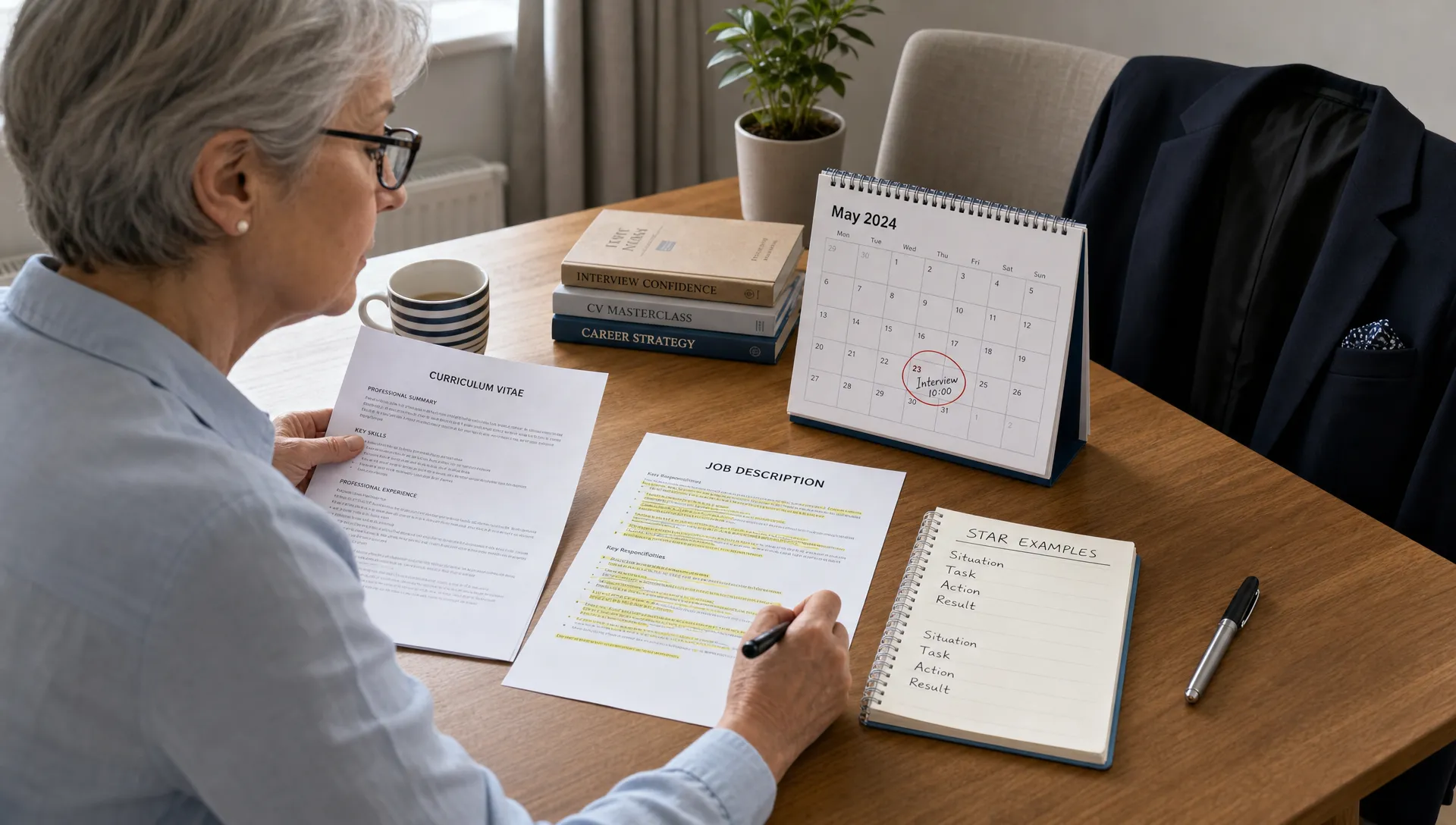
Summary: Strong answer preparation is based on evidence, structure, and controlled rehearsal. Build a flexible answer bank, tailor examples to the employer’s needs, use AI tools carefully, and practise until your delivery sounds clear, natural, and relevant rather than memorised.
How to Handle Virtual and In-Person Interviews Successfully
Job interview preparation for 2026 must include technical checks, professional virtual presence, and body language awareness for both online and face-to-face formats.
Virtual job interview UK formats are now a standard part of hiring, particularly for first-stage interviews, multi-location panels, and international teams. In-person interviews remain common for final stages, leadership roles, and positions where stakeholder presence matters. Both formats require preparation, but the risks differ.
Prepare your virtual interview setup
For a virtual interview, check your camera, microphone, lighting, internet connection, meeting link, username, and background in advance. Place the camera at eye level and look into it when delivering key points. Keep notes nearby, but do not read from them. If you use a second screen, make sure your eye movement does not make you appear distracted.
Your environment should support the impression you want to create. A plain, tidy background works better than a busy room. Silence notifications and close unnecessary tabs. Join early, but not excessively early. If there is a technical issue, acknowledge it calmly and offer a practical solution, such as rejoining, switching audio, or continuing by phone.
Prepare for in-person interview dynamics
For face-to-face interviews, plan your route, arrival time, clothing, documents, and reception etiquette. Arriving 10 minutes early is usually enough. Bring a copy of your CV, the job description, a notebook, and any portfolio or evidence if relevant to the role.
Body language matters, but it should be natural. Sit upright, maintain appropriate eye contact, and avoid over-nodding. In panel interviews, answer the person who asked the question while also including the wider panel with brief eye contact. If you need a moment to think, take it. A short pause often signals composure.
Adjust your communication by format
Virtual interviews reward concise answers because online conversations can feel more tiring and interruptions are harder to manage. In-person interviews allow more nuance, but they also reveal energy, confidence, and interpersonal judgement more clearly. In both settings, the best approach is structured warmth: professional, prepared, and human.
| Interview format | Main risk | Preparation priority |
|---|---|---|
| Virtual first stage | Sounding flat, distracted, or over-scripted | Test technology and practise concise delivery to camera |
| Virtual panel | Talking over others or losing rapport | Pause before answering and address the full panel |
| In-person final stage | Underplaying executive presence | Prepare examples, questions, and confident body language |
| Presentation interview | Too much detail or weak narrative | Build a clear argument with evidence and recommendations |
Summary: Interview format affects preparation. Virtual interviews require technical control and camera-aware delivery, while in-person interviews demand presence, timing, and interpersonal awareness. Preparing for both formats ensures your evidence is not undermined by avoidable practical issues.
Frequently Asked Questions
The most useful job interview preparation answers for UK professionals in 2026 combine early planning, focused research, careful use of technology, composure under pressure, and professional follow-up.
How far in advance should I start preparing for a job interview? Start as soon as the interview is confirmed, ideally five to seven days before the meeting. Senior and mid-level roles need more than a quick read-through of the job description because you must connect your experience to commercial priorities, leadership expectations, and stakeholder challenges. Use the first day for company and role research, the next two days to build STAR examples, and the final days for rehearsal and refinement. If the interview is urgent, prioritise the job specification, your CV, three relevant achievements, and two strong questions for the panel.
What should I research about the company before an interview? Research the organisation’s recent performance, services, customers, competitors, culture, leadership changes, and public priorities. Then study the role description line by line and identify where your evidence matches the required outcomes. For UK employers, also review the company’s values, sustainability statements, regulatory environment, and hiring team profiles on LinkedIn where available. The goal is not to recite facts. It is to show you understand the employer’s context and can explain how your experience helps solve the problems behind the vacancy.
How can I use AI tools to help with interview preparation? Use AI tools to generate practice questions, test the clarity of your answers, and identify gaps in your examples. Do not allow them to produce a script you repeat word for word, because generic phrasing can make a senior candidate sound less credible. A better approach is to ask for feedback on structure, brevity, evidence, and relevance. You can also use AI to simulate challenging follow-up questions. Review every output against your real achievements, sector language, and the specific job description before using it in rehearsal.
What is the best way to handle difficult or unexpected interview questions? Treat difficult questions as an opportunity to demonstrate judgement rather than perfection. Pause, acknowledge the question, and structure your answer before speaking. If you lack direct experience, use skills transfer by explaining a comparable situation, the decision you made, and the result you achieved. For negative topics, such as a missed target or a role that ended badly, stay factual and focus on learning, accountability, and changed behaviour. If a question is unclear, ask for clarification. Controlled thinking usually appears stronger than a rushed, unfocused answer.
How important is follow-up after a job interview? Follow-up is highly valuable when it is concise, timely, and specific. Send a short message within 24 hours thanking the interviewer, reaffirming interest, and referencing one or two points from the conversation. Avoid lengthy persuasion or adding new claims that were not discussed. For senior roles, a thoughtful follow-up can reinforce executive presence, listening skills, and alignment with the organisation’s priorities. It also gives you a professional way to clarify next steps. If you are not selected, a courteous follow-up can keep the relationship open for future opportunities.
Summary: The most effective interview preparation starts early, focuses on role-specific evidence, uses technology with judgement, and continues after the meeting through professional follow-up. These habits help candidates appear prepared, credible, and commercially aware.
Conclusion & Strategic Positioning
Structured job interview preparation is one of the highest-return activities in a UK job search because it converts experience into clear evidence, credible motivation, and controlled delivery.
For mid-senior professionals, the interview is not simply a conversation about previous roles. It is a test of relevance, judgement, communication, and confidence. For career changers, it is also the moment where skills transfer must become believable. The candidates who succeed in 2026 will be those who research the employer carefully, practise concise evidence-led answers, handle virtual and in-person formats professionally, and follow up with maturity.
Optima Career Studio supports professionals who want their positioning to match the level of roles they are pursuing. Through recruiter-led profile optimisation, CV and LinkedIn refinement, profile strategy audits, and career positioning advice, Optima helps candidates clarify their value before they enter the room. If you are preparing for a significant move, a senior interview, or a UK or European career transition, Optima’s career coaching support can help you approach the process with sharper messaging and greater confidence.