
2 July 2026
AI Job Search: How to Use AI Tools and Still Stand Out in 2026
AI can speed up your job search, but generic applications are easier than ever to spot. Learn how to use AI tools strategically while keeping your CV, cover letters and interview preparation credible, human and recruiter-ready.

AI has changed how professionals research roles, write applications and prepare for interviews. It has also made the job market noisier. Recruiters now see more polished but less distinctive CVs, cover letters and LinkedIn summaries, which means senior candidates need to use AI with more discipline, not less.
For mid-senior professionals, the opportunity is significant. AI can help you move faster, identify patterns in job descriptions and refine your messaging. The risk is equally clear: if your applications sound like everyone else’s, you become easier to ignore.
Why AI Tools Are Now Essential in a 2026 UK Job Search
An effective AI job search in 2026 combines AI tools for speed and efficiency with human oversight to ensure applications remain authentic and targeted.
An AI job search is the practice of using artificial intelligence tools to assist with CV writing, job matching, cover letters, interview preparation and application tracking during a professional job hunt. AI tools are software and platforms powered by artificial intelligence that automate or enhance tasks such as content generation, keyword optimisation and candidate-job matching.
For UK professionals, AI is no longer a novelty. It is becoming part of the normal workflow for researching employers, interpreting job descriptions and preparing tailored applications. The strongest candidates are not using AI to replace judgement. They are using it to remove friction from repetitive tasks so they can spend more time on positioning, evidence and decision quality.
Where AI creates the most value
AI is particularly useful when you are dealing with volume, complexity or uncertainty. A senior professional reviewing multiple possible routes can use AI to compare role requirements, extract repeated keywords and identify where their experience maps well to a target market.
AI can help with:
- Analysing job descriptions to identify must-have requirements, repeated phrases and implied priorities.
- Drafting first versions of CV bullets, cover letter sections and LinkedIn summaries.
- Translating technical or specialist experience into language that a broader hiring audience can understand.
- Preparing interview practice questions based on a real job description.
- Tracking applications, follow-ups and recruiter conversations more consistently.
The time saving can be substantial. Instead of starting every application from a blank page, you can create a structured draft quickly and then focus your effort on accuracy, relevance and persuasion.
Why AI cannot replace professional judgement
Recruiters are not only scanning for keywords. They are assessing commercial impact, credibility, motivation and fit. AI can suggest language, but it cannot decide which career story is most compelling for your next move. It cannot know which achievement mattered most in context, which stakeholder challenge was hardest to solve or why a career pivot makes strategic sense.
This is especially relevant for mid-senior candidates. A junior CV can often be improved by clearer formatting and better action verbs. A senior CV needs sharper judgement: what to leave out, what to lead with, how to show scope, and how to translate leadership into measurable business value.
The UK context matters
An AI job search UK strategy should account for local hiring expectations. UK CVs are usually concise, evidence-led and tailored to the role. Recruiters expect clear chronology, relevant achievements and a professional profile that quickly explains your value. Overly promotional wording, vague personal statements or inflated claims can work against you.
For European and North American applications, expectations can shift again. Terminology, resume length, personal information norms and achievement framing vary by market. AI can help adapt language, but it should not be trusted blindly across regions.
Structured summary: AI tools are now essential because they improve speed, research quality and application consistency. Their highest value comes from supporting analysis and drafting, while the candidate must still own the positioning, evidence and final message.
How to Use AI for CV and Cover Letter Creation Without Losing Your Voice
Using AI in an AI job search for CVs and cover letters works best when professionals provide specific prompts and then heavily edit the output to reflect their personal achievements and tone.
The quality of AI output depends on the quality of your input. If you ask for a “professional CV summary”, you will probably receive generic wording. If you provide a target role, your current CV, three measurable achievements and the tone you want, the result will be far more useful.
Start with evidence, not adjectives
AI often defaults to broad claims such as “strategic leader”, “results-driven professional” or “excellent communicator”. These phrases are not inherently wrong, but they only become persuasive when tied to evidence. Before using AI, gather the raw material that makes your application credible.
Useful inputs include revenue impact, cost savings, team size, markets covered, systems implemented, transformation outcomes, regulatory exposure, stakeholder groups and promotion history. For career changers, add examples of skills transfer, the process of identifying and applying professional competencies developed over time when adapting to new roles or industries.
If you are repositioning your background, this is where AI can help you see connections, but you should validate every conclusion. For a deeper framework on repositioning experience, Optima’s guide on how to explain a change in career on your CV is a useful companion.
Use prompts that give AI boundaries
A strong prompt gives the tool context, audience, constraints and evidence. It should make the output easier to edit, not harder to trust.
| Application task | Strong AI input | Human edit required |
|---|---|---|
| CV profile | Target job description, current seniority, 3 strongest achievements, preferred tone | Remove generic claims, sharpen positioning and ensure it sounds like you |
| Achievement bullets | Project context, action taken, metrics, stakeholders, outcome | Check accuracy, add nuance and prioritise the most relevant results |
| Cover letter | Role motivation, employer context, career rationale, proof points | Make the opening more personal and remove formulaic phrasing |
| LinkedIn summary | Target audience, career direction, leadership strengths, sector keywords | Add personality, commercial focus and a credible narrative thread |
A good prompt might say: “Rewrite the following CV profile for a UK Head of Operations role in a professional but understated tone. Prioritise operational transformation, cost reduction and cross-functional leadership. Avoid clichés. Use only the evidence provided.”
That kind of instruction reduces the risk of exaggerated or bland content. It also forces the tool to work within your real experience.
Edit for rhythm, credibility and recruiter relevance
Once AI produces a draft, read it as a recruiter would. Does it answer the job brief quickly? Does it show scale? Does it sound like a real person? Does it overstate anything? Would you feel confident discussing every line in an interview?
Your CV profile deserves particular attention because it frames the rest of the document. If the opening paragraph is generic, the recruiter may never reach your strongest achievements. Optima’s article on how to write a CV profile that wins more interviews explains how to make that section sharper and more selective.
Structured summary: AI can accelerate CV and cover letter creation, but only when it is fed with accurate evidence and controlled by clear prompts. The final edit should restore your voice, remove generic phrasing and make the application specific to the role.
How to Stand Out When Everyone Is Using AI Tools
Standing out in an AI job search requires emphasising unique experiences, quantifiable results, and personal insights that AI cannot replicate.
When a large number of applicants use similar tools, surface-level polish becomes less valuable. A clean CV and fluent cover letter are now the baseline. Differentiation comes from substance: the decisions you made, the problems you solved, the trade-offs you managed and the results you can evidence.
Lead with what is difficult to copy
AI can imitate professional language, but it cannot invent your lived context without drifting into falsehood. Your advantage lies in details that are specific, verifiable and commercially meaningful.
For example, “led transformation initiatives” is easy to ignore. “Led a 14-month operating model redesign across 6 regional teams, reducing duplicated workflow and improving reporting speed by 35%” gives a recruiter something concrete to assess.
The same applies to leadership. Do not simply say you managed stakeholders. Explain the type of stakeholders, the complexity of the environment and the outcome of your influence. Senior hiring decisions are often based on judgement under pressure, not just task completion.
Build a narrative, not just documents
Your CV, LinkedIn profile, cover letter and interview answers should reinforce the same strategic message. If you are moving from finance into commercial operations, or from corporate leadership into consulting, AI can help you test different ways of framing the move. It should not create a different identity for every application.
A strong narrative usually answers four questions: what you are known for, where you have created value, why the target move makes sense and what evidence supports it. This is where human reflection matters. AI may generate options, but you must choose the message you are prepared to defend.
Use AI critically, not automatically
The best AI users are sceptical. They ask whether the output improves recruiter confidence or simply adds more words. This mirrors a wider challenge in AI adoption: tools only create value when users trust them and apply them at the right moment. Product teams working on AI adoption often use practical frameworks such as the AI Product Adoption Deck to diagnose where trust, usefulness and retention break down. Job seekers can apply a similar lens by asking whether each tool genuinely improves the quality of a hiring interaction.
If the output makes your application clearer, more relevant and more evidence-led, keep refining it. If it makes you sound polished but interchangeable, discard it.
Structured summary: To stand out with AI job search methods, focus on evidence AI cannot replicate: measurable achievements, context, judgement and a consistent career narrative. AI should sharpen your message, not flatten your individuality.
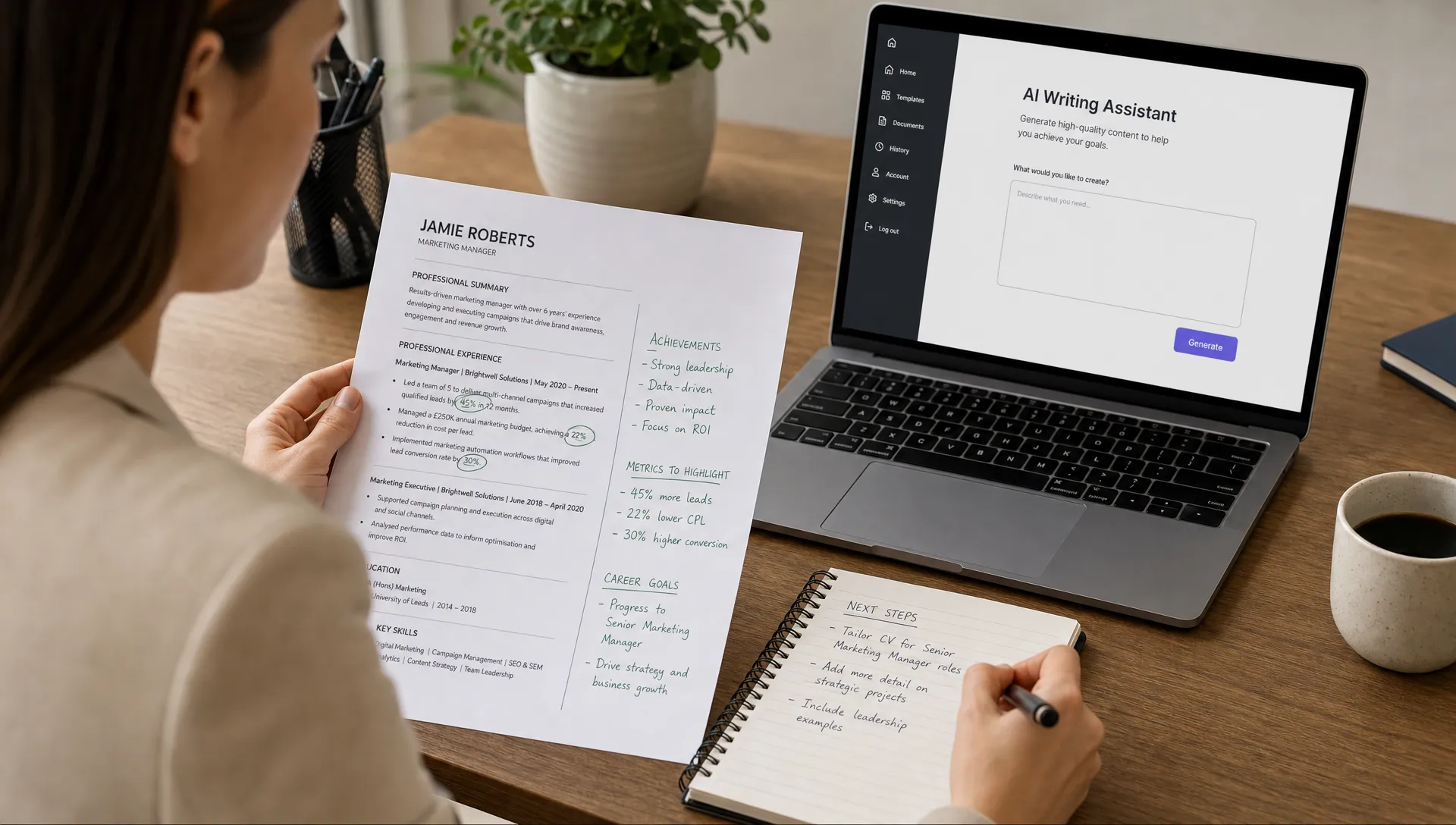
Common Mistakes Professionals Make When Relying on AI for Job Search
The biggest risk in an AI job search is over-reliance on generic AI-generated content that fails to connect with recruiters or demonstrate genuine fit.
AI can make weak applications look superficially better. That is useful up to a point, but it can also create a false sense of confidence. A polished application that lacks strategic positioning is still weak. For mid-senior professionals, the mistakes are usually less about grammar and more about judgement.
Mistake 1: Submitting the first draft
AI first drafts often contain repetitive phrasing, inflated adjectives and broad claims. They may also mirror the job description too closely, which can make the application feel mechanical. A recruiter can usually sense when a cover letter has been generated with minimal personal input.
Treat the first draft as raw material. Reorder it, remove filler and add detail from your real career. If you would not say a sentence out loud in an interview, it probably does not belong in your application.
Mistake 2: Optimising only for ATS keywords
Applicant tracking systems matter, but ATS compatibility is not the same as quality. A keyword-heavy CV that reads poorly will not persuade a recruiter. The best applications balance search relevance with human readability.
Use AI to identify recurring terms in job descriptions, then weave them into accurate achievement-led content. Do not add skills you cannot evidence. Do not repeat phrases unnaturally. The goal is to be findable and credible.
Mistake 3: Allowing AI to exaggerate
AI tools can turn modest inputs into confident claims. That may look impressive on paper, but it creates risk. If the CV says you “delivered enterprise-wide transformation” and you actually contributed to one workstream, the gap will surface in interview.
Accuracy protects your credibility. Strong positioning does not require exaggeration. It requires selecting the right evidence and presenting it clearly.
Mistake 4: Ignoring confidentiality
Do not paste sensitive employer data, private client information or commercially confidential material into AI tools. Remove names, figures that should not be shared and any information covered by internal policies. You can still describe the nature of the work without disclosing protected details.
| AI job search mistake | Why it weakens your application | Better approach |
|---|---|---|
| Using unedited AI text | Sounds generic and reduces trust | Rewrite around your own evidence and tone |
| Chasing keywords only | May pass a scan but fail recruiter review | Combine relevant keywords with readable achievements |
| Exaggerating impact | Creates interview and reference risk | State scope and results accurately |
| Applying the same version everywhere | Misses role-specific priorities | Tailor the profile, bullets and cover note for each role |
| Sharing confidential data | Creates professional and legal risk | Anonymise sensitive details before using AI |
Structured summary: The main AI job search mistakes are unedited drafts, keyword stuffing, exaggerated claims, generic tailoring and poor data judgement. Avoid them by keeping AI as a support tool and making every final decision yourself.
Frequently Asked Questions
The most effective AI job search answers are practical: use AI to improve preparation, but keep human judgement in control.
Is using AI in a job search considered cheating? No. Using AI in a job search is not cheating if the final application accurately represents your real experience, skills and motivation. It becomes a problem when candidates allow AI to invent achievements, inflate responsibilities or produce answers they cannot defend. Recruiters expect professionals to use modern tools, but they still evaluate credibility, judgement and fit. Think of AI as an assistant for research, drafting and preparation. You remain responsible for the truth, relevance and tone of everything submitted under your name.
Which AI tools are most useful for UK job seekers in 2026? The most useful AI tools for UK job seekers are those that improve clarity and decision-making rather than simply producing more text. Generative writing tools can help draft CV sections and cover letters. Job matching platforms can identify relevant roles. Keyword and ATS checkers can highlight missing terminology. Interview preparation tools can generate practice questions from job descriptions. Application trackers can help manage follow-ups. The best setup is usually simple: one tool for drafting, one for role analysis and one system for tracking activity.
How can I make my AI-assisted CV stand out to recruiters? Make your AI-assisted CV stand out by replacing generic claims with specific evidence. Add metrics, scope, business context and leadership complexity wherever possible. A recruiter should quickly understand what you improved, how you influenced the outcome and why that experience matters for the target role. Use AI to test wording, but do not let it remove your judgement or personality. The strongest CVs are selective. They do not list everything. They prioritise the experience most relevant to the role and present it in credible, concise language.
Should I disclose that I used AI to write my application? You usually do not need to disclose that you used AI to support your application unless the employer specifically asks. AI is a tool, like a spellchecker, template or coaching resource. The key issue is ownership. If the content is accurate, personally reviewed and genuinely reflects your background, disclosure is rarely necessary. If an employer has a policy requiring candidates to state whether AI was used, follow it. Never use AI to complete assessments dishonestly, impersonate your thinking or misrepresent your experience.
How long should I spend editing AI-generated job search content? For a serious application, expect to spend at least 30 to 60 minutes editing AI-generated content, and longer for senior or executive roles. The higher the role, the more judgement the application requires. Editing should cover accuracy, tone, relevance, evidence and flow. Compare the final version against the job description and remove anything that feels vague or inflated. A useful rule is that AI can create the structure, but the strongest 70% of the final quality should come from your own decisions.
Conclusion & Strategic Positioning
AI is a powerful job search enabler when it is paired with authentic human input, recruiter-aware positioning and disciplined editing.
For mid-senior professionals, the advantage in 2026 is not simply knowing which AI tools to use. It is knowing when to use them, what to ignore and how to turn your real experience into a clear market message. AI can help you move faster, but speed alone does not win interviews. Relevance, credibility and confidence still do.
The strongest applications blend technology with professional judgement. They use AI to analyse, structure and refine, while relying on human insight to choose the right story, evidence and tone. That balance is especially important for career pivots, leadership moves and senior appointments where generic wording can quickly weaken perceived fit.
Optima Career Studio helps professionals apply that balance through recruiter-led CV, resume and LinkedIn optimisation, profile strategy and career coaching. If you want to use AI effectively without losing your distinctive professional edge, expert review can help turn a faster job search into a more focused and credible one.