
18 June 2026
How to Explain a Change in Career on Your CV
A career change does not have to look risky on your CV. Learn how to connect your past achievements to your new direction with clear positioning, relevant evidence, and recruiter-friendly wording.

Changing career can feel harder to write than to talk about. In conversation, you can explain your reasons, your ambition and the logic behind the move. On a CV, you have a few seconds to make the same point before a recruiter decides whether your experience is relevant.
The good news is that a change in career does not have to look like a risk. A well-positioned CV can make it look deliberate, credible and commercially useful. The aim is not to apologise for your transition or over-explain your personal journey. The aim is to show how your previous experience makes you valuable in the role you want next.
For mid-level and senior professionals, this is especially important. You are not just changing job titles. You may be changing sector, function, operating model or level of responsibility. Your CV needs to help the reader understand the move quickly, while still preserving the authority you have already built.
Start with the hiring question, not your biography
Recruiters are not usually against career change. They are against unclear fit. When your CV lands in front of a hiring team, they are trying to answer a few practical questions:
- Can this person do the role with limited ramp-up time?
- Do they understand the environment they are moving into?
- Are their achievements relevant to our problems?
- Is this move intentional, or are they applying broadly?
Your CV should answer those questions before the recruiter has to ask them. That means leading with relevance, not chronology alone.
The National Careers Service guidance on changing career rightly encourages people to identify transferable skills and research their target role. On a CV, the next step is translation. You need to translate what you have done into the language of the job you now want.
For example, a senior retail manager moving into operations does not need to describe every shop-floor responsibility. They need to highlight workforce planning, process improvement, regional performance, supplier coordination, cost control and customer experience metrics. The past has not changed, but the framing has.
Identify the type of career change you are making
Not all career changes need the same explanation. A sector change is different from a functional change. A move from permanent employment into consulting is different from a move from finance into sustainability.
Use the table below to decide what your CV needs to emphasise.
| Type of career change | Likely recruiter concern | What your CV should emphasise |
|---|---|---|
| Same role, new sector | Will they understand our market? | Comparable clients, regulations, stakeholders, scale and operating pressures |
| Same sector, new function | Do they have the technical capability? | Relevant projects, cross-functional work, training and measurable outcomes |
| Corporate to start-up or scale-up | Can they work with ambiguity and pace? | Ownership, adaptability, resourcefulness and hands-on delivery |
| Specialist to leadership | Can they influence beyond technical work? | Team leadership, strategy, stakeholder management and commercial impact |
| Leadership to consulting or fractional work | Can they package expertise clearly? | Advisory value, transformation work, board-level communication and repeatable frameworks |
Once you know the type of transition, your CV becomes easier to shape. You are no longer trying to explain everything. You are addressing the specific doubt that could stop you being shortlisted.
Use a hybrid CV structure, not a fully functional CV
Career changers are often tempted to use a functional CV that hides dates and groups everything by skill. For senior professionals, that can backfire. Recruiters still want to see progression, scope and credibility. If the structure looks evasive, it may create more questions than it answers.
A hybrid CV is usually stronger. It keeps a clear reverse-chronological career history, but it adds a focused profile, skills section and selected achievements near the top. This gives the recruiter context before they read your previous job titles.
| CV section | How to use it during a career change | Example focus |
|---|---|---|
| Professional profile | State your current value and target direction | Commercial leader moving into customer success leadership |
| Key skills | Mirror the target role language truthfully | Stakeholder engagement, operational improvement, governance, transformation |
| Selected achievements | Prove transferable impact early | Delivered £2m cost reduction through process redesign |
| Career history | Keep dates and employers clear, but reframe bullets | Emphasise relevant projects over routine duties |
| Qualifications and development | Show commitment to the new direction | Certifications, sector training, professional memberships |
This structure also helps with applicant tracking systems, often called ATS. Standard headings, clear dates and relevant terminology make your CV easier to parse, while the top sections help human readers understand your positioning.
Write a profile that builds the bridge
Your professional profile is the most important place to explain your career change on your CV. It should be short, confident and specific. Think of it as the bridge between where you have been and where you are going.
A useful formula is: proven background, relevant strengths, target direction and evidence.
For example:
Operations to project management: Operations leader with 10 years of experience improving multi-site performance, workforce planning and service delivery. Now targeting project management roles where process improvement, stakeholder coordination and delivery discipline are central to successful change.
Finance to commercial strategy: Qualified finance professional with a strong record of partnering with senior stakeholders to improve forecasting, margin visibility and investment decisions. Seeking commercial strategy roles that require analytical rigour, business partnering and board-level insight.
Marketing to customer success: B2B marketing manager with experience using customer insight, lifecycle communications and retention data to improve engagement. Moving into customer success roles focused on adoption, relationship growth and customer value.
Notice what these examples do not do. They do not say the candidate is starting from scratch. They do not overstate experience they do not have. They connect existing evidence to the future role.
Avoid weak profile wording such as: looking for a new challenge, passionate about changing career, or keen to use my transferable skills. These phrases are too vague. Recruiters need to know which skills, for which role, and why they matter.
Reframe experience around transferable value
The career history section is where many career-change CVs lose momentum. Candidates often leave old bullet points unchanged, which means the recruiter has to do the work of interpreting relevance. Do not make them work that hard.
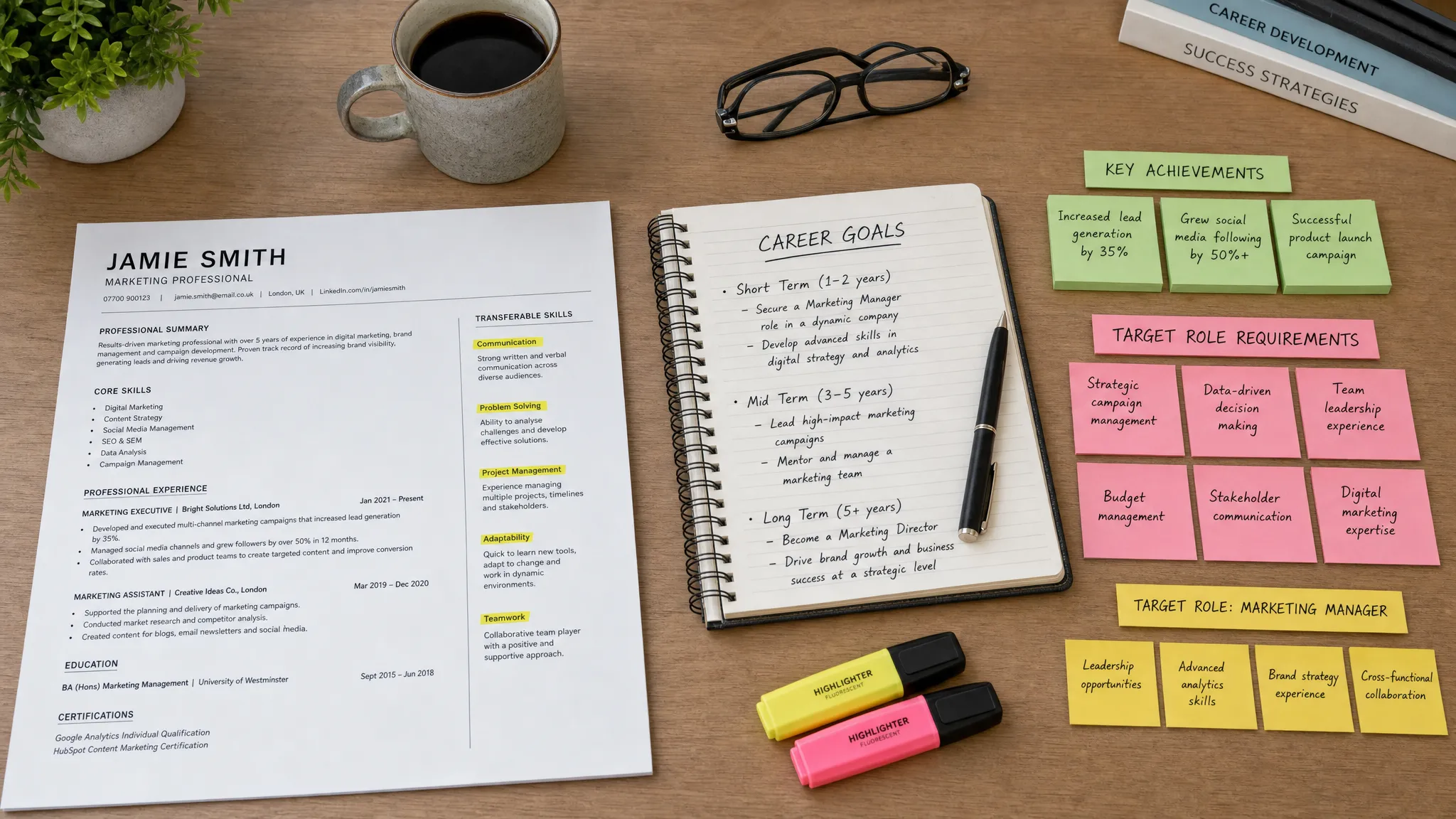
Start with the job description for your target role. Highlight the repeated requirements, such as governance, stakeholder management, analytics, client delivery, transformation, compliance, people leadership or commercial planning. Then look back through your experience and identify where you have already demonstrated those capabilities.
The point is not to distort your background. It is to bring the most relevant evidence to the surface.
| Original CV wording | Stronger career-change wording | Why it works |
|---|---|---|
| Managed weekly team meetings and reporting | Led weekly performance reviews, using service data to identify delivery risks and agree corrective actions with department leads | Shows operational control, data use and stakeholder coordination |
| Responsible for customer enquiries | Managed high-value client escalations, resolving service issues while protecting retention and commercial relationships | Reframes service work as relationship and risk management |
| Helped with internal system rollout | Supported cross-functional implementation of a new CRM, coordinating user feedback, training needs and adoption tracking | Connects the task to change, systems and adoption |
For senior roles, focus especially on scale. Mention budgets, regions, teams, revenue, client segments, operating complexity and decision-making level where accurate. Scale helps recruiters understand whether your experience can transfer into their environment.
Make your CV readable for ATS and human reviewers
A career change CV needs to be clear for both software and people. ATS platforms can only work with the information present in your document. If your target role requires vendor management, risk reporting or product delivery, and you have done those things, use that wording naturally in your CV.
The CIPD recruitment factsheet highlights the importance of defining the role and person requirements during recruitment. Your CV should reflect those requirements without copying the job advert line by line.
Use standard section headings such as Professional Experience, Key Skills, Education and Certifications. Avoid graphics, text boxes and unusual layouts if they make the content harder to read. A polished CV is useful, but a readable CV is essential.
Explain the reason for the move briefly
You do not always need a dedicated career change statement. In many cases, your profile and achievements are enough. But if the move is significant, a concise line can help remove doubt.
Keep it professional and forward-looking. The CV is not the place for a long explanation about burnout, conflict, redundancy or dissatisfaction. Even if those factors are true, employers respond better to a positive rationale based on direction, contribution and fit.
| Situation | CV wording you could adapt |
|---|---|
| Moving from corporate leadership to consulting | Transitioning into advisory work after leading large-scale transformation programmes across complex stakeholder environments |
| Moving from sales into customer success | Refocusing on post-sale customer value, using a background in enterprise relationship management, retention and revenue growth |
| Moving from education into learning and development | Bringing experience in curriculum design, facilitation and learner engagement into corporate learning and development |
| Moving from finance into sustainability | Applying financial analysis, reporting discipline and governance experience to sustainability and ESG-focused business roles |
The wording should feel like a strategic move, not a confession. One or two lines are enough.
Keep your seniority visible, even if the sector is new
A common mistake among experienced professionals is to make themselves look too junior when changing direction. They strip out leadership, commercial responsibility and strategic work because they worry it is not directly relevant. This can weaken the CV.
If you are senior, your seniority is part of the value you bring. The target employer may still benefit from your judgement, stakeholder confidence, people leadership and ability to operate in complex environments. Even if you are moving into a new function, do not reduce your CV to a list of basic tasks.
That said, you may need to adjust the emphasis. If you are moving from director-level operations into a product operations role, your CV should still show leadership, but it should prioritise process design, operating cadence, cross-functional delivery, metrics and systems. You are not pretending to be a lifelong product specialist. You are showing why your operating experience is relevant.
If you are intentionally stepping into a less senior role to enter a new field, be clear about your motivation in the profile or cover letter. Recruiters may otherwise assume you are overqualified, too expensive or unlikely to stay.
What not to include when explaining a career change
A strong CV is selective. It does not need every reason, every task or every personal detail. In fact, too much explanation can make the transition feel less confident.
Avoid these common mistakes:
- Overusing the phrase transferable skills without proving them through achievements.
- Hiding employment dates or job titles to disguise the transition.
- Leading with personal motivation before professional relevance.
- Listing courses above substantial career achievements unless the qualification is essential.
- Copying target job descriptions without evidence from your own experience.
- Making the CV too long because you are trying to explain every step.
For most mid-level and senior professionals, two pages is still the ideal CV length in the UK and Europe. In North America, resume expectations can vary by sector and seniority, but clarity and relevance still matter more than volume.
Align your CV, LinkedIn profile and cover letter
Your CV should prove fit. Your cover letter can explain motivation in slightly more detail. Your LinkedIn profile should reinforce the same positioning publicly. If these three tell different stories, your career change can feel uncertain.
For example, if your CV positions you for transformation roles but your LinkedIn headline still presents you only as a finance manager, recruiters may hesitate. If your cover letter says you are committed to sustainability but your CV contains no sustainability-related projects, training or sector language, the claim feels unsupported.
Consistency matters. Use the same target direction, the same core strengths and the same evidence across your application materials. You do not need identical wording, but you do need a coherent story.
A quick checklist before sending your CV
Before applying, review your CV through the eyes of a recruiter who does not know you. Ask whether the transition is obvious, logical and evidenced.
Use this checklist:
- The profile explains the bridge between your past experience and target role.
- The key skills section uses truthful language from your target market.
- The first half of page one contains evidence relevant to the new direction.
- Career history bullets focus on outcomes, scale and transferable impact.
- Training or qualifications support the transition without overshadowing experience.
- The CV does not sound apologetic, defensive or vague.
- LinkedIn and cover letter messaging support the same career move.
If the answer is yes, your career change is no longer a problem to explain. It becomes a positioning decision.
Frequently Asked Questions
Should I mention my career change in the CV profile? Yes, if the change is not immediately obvious from your job titles. A short profile can explain the bridge between your previous experience and your target role without taking up too much space.
Is a functional CV best for a career change? Usually not for mid-level and senior professionals. A hybrid CV is often stronger because it highlights relevant skills and achievements while still showing clear dates, employers and career progression.
How do I explain a career change without sounding inexperienced? Focus on transferable outcomes, scale and business impact. Avoid saying you are starting over. Instead, show how your existing experience solves problems in the new role or sector.
Should I include courses or certifications at the top of my CV? Include them where they strengthen your case, especially if they are required or highly relevant. However, substantial achievements and professional credibility should usually remain more prominent than short courses.
Can I use the same CV for every career change application? No. You can keep a core version, but you should tailor the profile, skills and achievement emphasis for each target role. Career change applications need especially clear alignment.
Ready to make your career change clearer?
If your CV is accurate but not yet convincing, the issue may be positioning rather than experience. A recruiter-led review can help you identify what to emphasise, what to remove and how to make the transition easier for hiring teams to understand.
Optima Career Studio provides recruiter-led CV, resume and LinkedIn profile optimisation for professionals across UK, European and North American hiring markets, with services starting from £49. If you are changing career, a profile audit or CV review can help turn a complex background into a clearer, more shortlist-ready story.