
18 June 2026
How to Write a CV Profile That Wins More Interviews
Your CV profile is often the first section a recruiter reads, so it has to earn attention quickly. This guide shows you how to position your value, prove impact, and tailor your opening summary for more interviews.

A strong CV profile can do more for your interview rate than most people realise. It sits at the top of your CV, usually just below your name and contact details, and it often decides whether a recruiter keeps reading or moves on.
For senior professionals, the challenge is not usually a lack of experience. It is clarity. Recruiters need to understand your level, specialism, value, and relevance quickly. A well-written CV profile gives them that context before they reach your career history.
The best profiles are short, specific, and evidence-led. They do not list every skill you have. They position you as the right candidate for a particular type of role.
What is a CV profile?
A CV profile is a brief professional summary at the top of your CV. It is sometimes called a personal profile, professional summary, executive summary, or resume summary in North American markets. The wording differs by region, but the purpose is the same: to introduce your professional value in a focused way.
A strong CV profile should usually be around 70 to 120 words, or 4 to 6 lines on the page. It should summarise who you are professionally, what you are known for, the scale of your experience, and why you are relevant to the role.
The National Careers Service guidance on CV sections describes the profile as a place to highlight skills, experience, and career aims. For competitive professional roles, you need to go further than that. Your profile should not just say what you want. It should show why the employer should want to speak to you.
Why your CV profile affects interview success
Recruiters and hiring managers rarely read a CV from top to bottom on the first pass. They scan for fit. A widely cited eye-tracking study by TheLadders found that recruiters spent an average of 7.4 seconds on an initial resume screen. Exact timings vary by sector and seniority, but the principle holds: your opening section must communicate value fast.
Your CV profile helps in three practical ways.
First, it frames the rest of your CV. If your profile says you are a transformation-focused Finance Director with multi-site experience, the reader knows what evidence to look for in your career history.
Second, it improves role alignment. Many senior professionals have broad experience, but broad can look unfocused. A tailored profile turns a general career history into a clear proposition for a specific vacancy.
Third, it supports ATS readability. Applicant tracking systems are used to store, search, and filter CVs. A natural profile that includes relevant job titles, functional expertise, tools, sectors, and leadership scope can help your CV align with recruiter searches, without sounding robotic.
The core ingredients of a high-performing CV profile
A CV profile that wins interviews usually includes five ingredients. You do not need to force all of them into every sentence, but the finished profile should cover most of them clearly.
| Ingredient | What it tells the recruiter | Example |
|---|---|---|
| Professional identity | Your target level and function | Senior HR Business Partner, Commercial Director, Data Lead |
| Scope and context | The scale of your experience | Global teams, regulated markets, private equity-backed growth |
| Value proposition | What you help organisations achieve | Revenue growth, operational improvement, risk reduction |
| Evidence | Why your claims are credible | £12m cost reduction, 30 percent faster delivery, 200-person team |
| Role fit | Why you match this opportunity | SaaS scale-up, FMCG, financial services, transformation programme |
The strongest profiles combine positioning and proof. They do not rely on adjectives such as dynamic, motivated, strategic, or results-driven unless those words are supported by concrete evidence.
A simple formula for writing your CV profile
Use this structure if you are starting from a blank page. It works for UK CVs, European CVs, and North American resumes, although terminology and length may vary slightly by market.
- Start with your professional label: Lead with the role title, function, or professional identity you want recruiters to associate with you, such as Senior Product Manager, Finance Director, Cyber Security Consultant, or Operations Leader.
- Add your area of expertise: Mention your sector, business environment, or specialist focus, such as B2B SaaS, manufacturing, healthcare, banking, supply chain, compliance, or transformation.
- State the value you create: Explain the business outcome you are known for, such as improving profitability, leading change, scaling teams, reducing operational risk, or building high-performing functions.
- Include measurable proof: Add one or two credible indicators of achievement, such as revenue, budget size, team size, cost savings, growth percentage, project scale, or market coverage.
- Match the target role: Reflect the priorities of the vacancy, including relevant leadership scope, technical skills, commercial focus, international exposure, or stakeholder complexity.
- Keep the tone concise: Write in clear professional language, avoid first-person pronouns where possible, and remove any phrase that could appear on hundreds of other CVs.
This formula keeps your profile focused on what recruiters need to know, rather than turning it into a career biography.
Gather the right evidence before you write
Many CV profiles fail because they are written before the candidate has clarified their value. Before drafting, review your last three to five roles and identify the achievements that best support your target direction.
Useful evidence can include:
- Commercial outcomes, including revenue growth, margin improvement, cost reduction, or retained business.
- Leadership scope, including team size, matrix leadership, regional responsibility, or board-level influence.
- Transformation results, including systems implemented, processes redesigned, or underperforming functions turned around.
- Market context, including start-up, scale-up, enterprise, private equity, public sector, regulated, or international environments.
- Technical or functional expertise, including tools, methodologies, governance frameworks, or specialist credentials.
- Stakeholder complexity, including C-suite engagement, investor reporting, union environments, client leadership, or cross-border collaboration.
If you cannot prove a claim somewhere else in your CV, be careful about placing it in your profile. The profile should act as a signpost to evidence, not a substitute for it.
CV profile examples: weak vs strong
The difference between a weak and strong CV profile is often not the candidate's experience. It is the specificity of the positioning.
| Weak profile | Why it underperforms |
|---|---|
| Experienced manager with excellent communication skills and a proven track record of delivering results. Hardworking, organised, and able to work well independently or as part of a team. Seeking a challenging new role in a growing organisation. | Too generic. It gives no role target, sector, scale, measurable achievement, or reason to shortlist the candidate. |
A stronger version would be:
Commercially focused Operations Manager with 10 years of experience improving service delivery, cost control, and team performance across multi-site logistics environments. Known for leading process improvement, supplier management, and workforce planning initiatives that reduced operating costs by £1.8m while improving fulfilment accuracy. Comfortable partnering with senior leadership, finance, and frontline teams to deliver practical change in fast-moving operational settings.
This profile works because it tells the reader the candidate's function, environment, strengths, commercial impact, and stakeholder level.
Here is another example for a senior professional targeting executive roles:
Finance Director with extensive experience leading financial strategy, governance, and performance improvement for private equity-backed and founder-led businesses. Track record of building scalable finance functions, strengthening reporting, and supporting growth through acquisitions, cash flow improvement, and board-level decision support. Recognised for combining commercial insight with operational discipline across organisations undergoing rapid change.
Notice that the profile does not try to cover every responsibility. It selects the points most likely to matter for the target role.
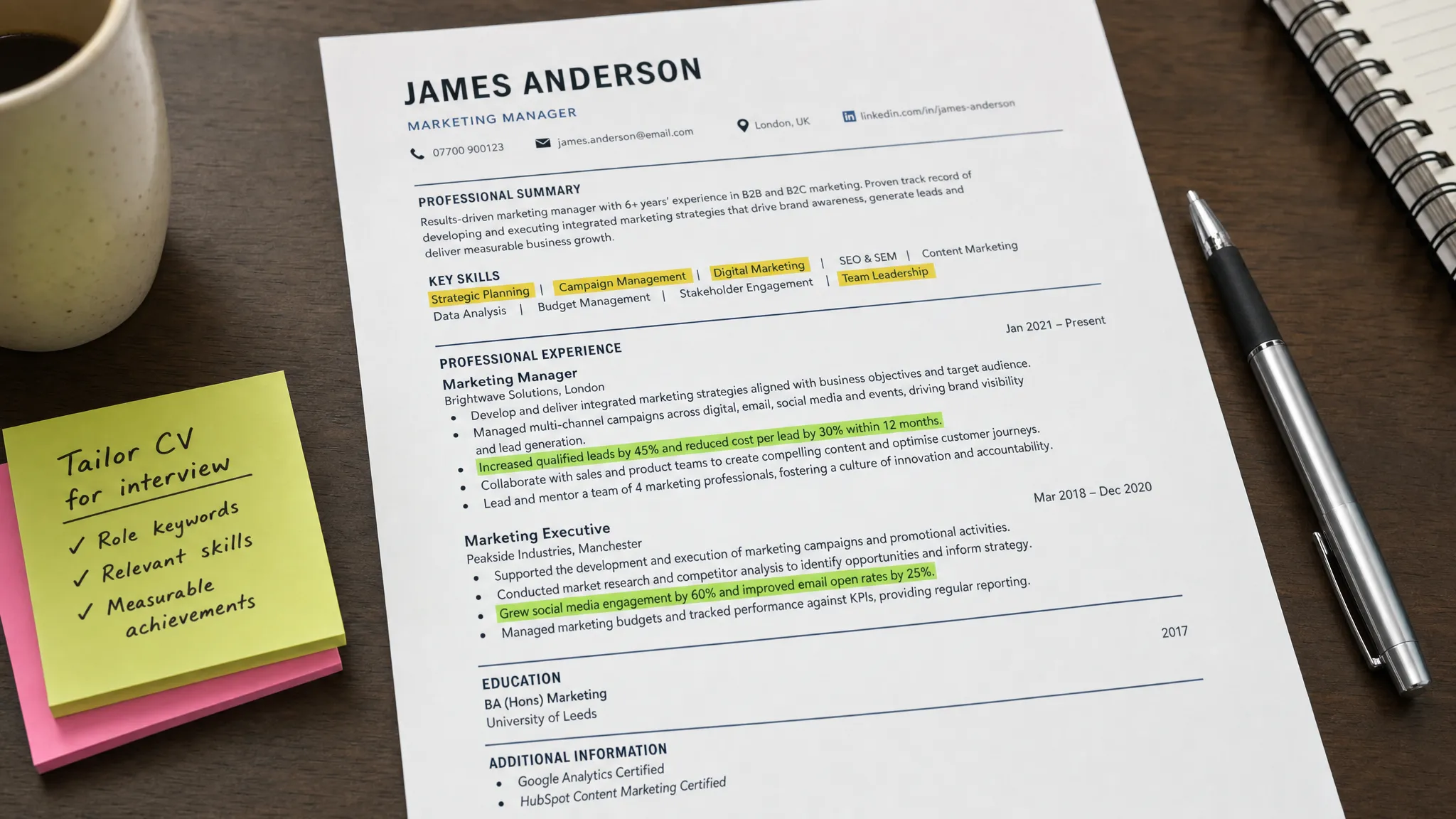
How to tailor your CV profile for each application
You do not need to rewrite your entire CV profile for every role, but you should tailor it enough to reflect the vacancy. A generic profile may be efficient, but it often weakens your interview conversion rate.
Start by reading the job description and identifying the top five priorities. These are often repeated in the role summary, key responsibilities, and person specification. Look for patterns around leadership, sector experience, transformation, systems, technical capability, client management, commercial ownership, or regulatory knowledge.
Then adjust your profile to bring the most relevant evidence forward. For example, if the role focuses on post-merger integration, your profile should mention integration, change leadership, stakeholder management, and measurable delivery. If the role focuses on revenue growth, your profile should foreground sales performance, market expansion, client retention, or commercial strategy.
A useful approach is to create a master profile and then adapt 20 to 30 percent of it for each application. Keep your professional identity and strongest proof consistent, but vary the sector language, role priorities, and final positioning sentence.
Make your CV profile ATS-friendly without making it robotic
An ATS-friendly CV profile is not a block of keywords. Recruiters still read it, and awkward keyword stuffing can damage your credibility. The aim is to use the same language a recruiter would use when searching for someone like you.
For example, a senior project professional might naturally include terms such as programme delivery, stakeholder management, governance, budget ownership, Agile, ERP implementation, or change management if those terms are accurate and relevant.
The key is to integrate keywords into meaningful sentences. Instead of listing skills in isolation, connect them to outcomes. Programme delivery becomes led a £6m transformation programme across finance and operations. Stakeholder management becomes partnered with C-suite stakeholders across legal, technology, and commercial functions.
This balance helps both systems and humans understand your fit.
Common CV profile mistakes that cost interviews
Even experienced professionals make avoidable mistakes in this section. The most common issue is writing a profile that sounds impressive but says very little.
| Mistake | Why it weakens your CV | Better approach |
|---|---|---|
| Opening with clichés | Recruiters see the same phrases constantly | Lead with role identity and specialist value |
| Trying to include everything | The message becomes diluted | Select the experience most relevant to the target role |
| Using only responsibilities | Responsibilities do not prove performance | Include outcomes, scale, and measurable impact |
| Writing a career objective | Employers care first about value and fit | Focus on what you can deliver for the organisation |
| Making it too long | Dense paragraphs reduce scanability | Keep it to 4 to 6 lines with clear, direct wording |
| Ignoring the job description | The profile feels disconnected from the role | Mirror the role's priorities where they match your experience |
Another common mistake is using the same CV profile for different career directions. If you are applying for both Chief Operating Officer and Transformation Director roles, your profile should not be identical. The overlap may be significant, but the emphasis should change.
How long should a CV profile be?
For most professionals, 70 to 120 words is enough. Junior candidates may need less. Senior executives may occasionally need slightly more, particularly if they are summarising international leadership, board exposure, and complex transformation experience. Even then, the profile should remain tight.
A good test is to read your profile aloud. If it feels like a speech, it is too long. If the recruiter cannot identify your target role, level, and value within the first two lines, it needs sharpening.
Also consider visual density. A 100-word profile can look readable if it is well spaced and direct. A 100-word profile can also look overwhelming if it is packed with long clauses, acronyms, and vague claims.
A practical CV profile template
Use this template as a starting point, not a script. The best profiles sound specific to you, your market, and your target role.
[Professional title] with experience in [sector, function, or business context], specialising in [core strengths]. Known for [business outcome or value proposition], with a track record of [measurable proof or major achievement]. Experienced in [relevant tools, environments, leadership scope, or stakeholder groups]. Now positioned for roles requiring [target role priority, such as growth, transformation, governance, operational improvement, or commercial leadership].
Here is how that might look in practice:
Senior Marketing Leader with experience across B2B technology and professional services, specialising in demand generation, brand positioning, and commercial growth. Known for building scalable marketing functions, improving pipeline quality, and aligning sales and marketing teams around measurable revenue outcomes. Experienced in leading multi-channel campaigns, agency partnerships, CRM optimisation, and board-level reporting in high-growth environments.
The template helps you structure the message, but the proof points make it credible.
When to get expert help with your CV profile
If you are applying consistently and not winning interviews, your CV profile may not be doing its job. This is especially common when your background is strong but complex, such as after a career pivot, redundancy, international relocation, promotion into senior leadership, or a move from corporate to scale-up environments.
It can also happen when your CV is too internally focused. Many professionals describe their role in the language their current employer uses, rather than the language recruiters and hiring managers search for. That gap can reduce shortlist probability even when the experience is relevant.
A recruiter-led review can help identify whether your profile is aligned with the roles you want, whether it is ATS compatible, and whether your positioning is clear enough for UK, European, or North American hiring standards.
Frequently Asked Questions
What should I include in a CV profile? Include your professional identity, target function, sector or environment, core strengths, measurable achievements, and the value you bring to the employer. Keep it focused on the role you want next.
How long should a CV profile be? Most CV profiles should be around 70 to 120 words, or 4 to 6 lines. The goal is to give recruiters enough context to keep reading, without turning the opening section into a full career history.
Should a CV profile be written in first person? In UK and European CVs, it is common to omit first-person pronouns and write in a concise professional style. For example, use Commercially focused Finance Manager rather than I am a commercially focused Finance Manager.
Can a CV profile help with ATS systems? Yes, if it uses relevant role titles, skills, sector terms, and functional keywords naturally. However, ATS compatibility depends on the whole CV, including formatting, headings, job titles, skills, and work experience.
Do I need a different CV profile for every job? You should adapt your profile for each application, but you do not need to start from scratch. Keep your core positioning consistent and tailor the emphasis to match the role's top priorities.
Improve your CV profile with recruiter-led support
Your CV profile should make your value obvious within seconds. If it does not, strong experience can be overlooked before a recruiter reaches your achievements.
Optima Career Studio provides recruiter-led CV, resume, and LinkedIn profile optimisation for professionals across UK, European, and North American hiring markets. Services include CV reviews, ATS compatibility checks, profile strategy audits, rewriting, LinkedIn optimisation, and executive profile support, with options starting from £49 and typical delivery in 2-7 days.
If your CV is not generating the interviews your experience deserves, refining your profile is one of the highest-impact places to start.