
11 July 2026
Interview Preparation for Career Changers: Acing Interviews in a New Industry in 2026
Changing industry changes the interview challenge. Learn how to translate experience, research the market, use AI practice tools, and answer behavioural questions with confidence in 2026.
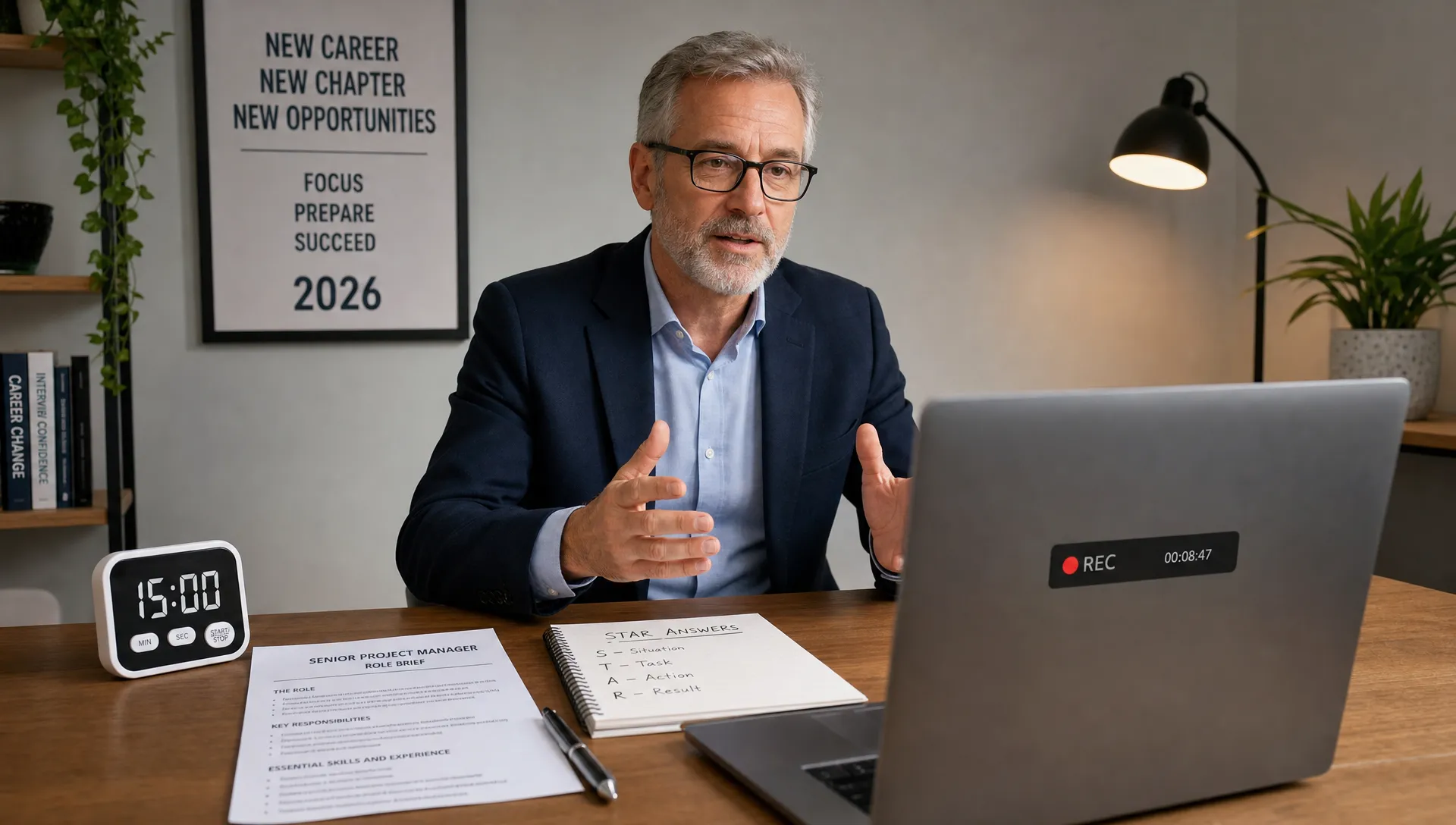
Why Interview Preparation Is Essential for Career Changers in 2026
Interview preparation for career changers enables professionals to confidently demonstrate how their existing experience translates to new-industry roles despite lacking direct domain background. Interview preparation for career changers is the structured process of researching, rehearsing, and positioning transferable skills to succeed in interviews for roles in a new industry or function.
For mid-senior professionals, a career change interview is rarely just about enthusiasm. Hiring teams want to know whether you can operate at the required level, learn the market quickly, and apply judgement from your previous experience without over-relying on old-sector assumptions. Your interview performance must make that connection easy for them to see.
By 2026, UK and international hiring processes are also more varied. Candidates may face live video interviews, asynchronous recorded questions, competency panels, case discussions, stakeholder simulations, and AI-supported screening workflows. A strong CV can secure attention, but the interview decides whether your transition feels credible, low risk, and commercially useful.
For a wider foundation on interview structure, research, and delivery, Optima Career Studio has a broader UK interview preparation framework that complements the career-change specific guidance in this article.
Career changers are usually assessed across four dimensions:
| Interview concern | What the interviewer is testing | How preparation helps |
|---|---|---|
| Relevance | Whether your background genuinely fits the new role | You translate achievements into the employer's language |
| Commitment | Whether the move is intentional rather than reactive | You explain a clear, considered career rationale |
| Speed to value | Whether you can contribute without lengthy hand-holding | You show learning agility and practical onboarding thinking |
| Senior credibility | Whether your level matches the role despite sector change | You evidence judgement, leadership, and commercial outcomes |
Skills transfer is the process of identifying and applying professional competencies developed over time when adapting to new roles or industries. For example, a finance leader moving into commercial operations may transfer forecasting, governance, stakeholder management, and performance improvement skills. A senior teacher moving into learning and development may transfer facilitation, curriculum design, assessment, and behavioural insight.
The key is not to claim that everything transfers equally. Strong candidates identify which experience is directly relevant, which needs reframing, and which gaps require a learning plan. That balance signals self-awareness, not insecurity.
Structured summary: Career changers are assessed on relevance, credibility, commitment, and speed to value. Strong preparation turns your previous experience into evidence for the future role, helping interviewers see continuity rather than a disconnected move.
How to Research the Role, Company, and Industry Effectively
Interview preparation for career changers begins with deep research into the target company, role requirements, and industry trends to tailor responses and ask insightful questions. Without research, even strong professionals sound generic because they explain their past rather than linking it to the employer's current problems.
Start with the role description. Do not simply read it, convert it into an interview scorecard. Identify the repeated verbs, priority outcomes, stakeholder groups, tools, compliance requirements, and leadership expectations. If a job description mentions transformation, customer retention, margin improvement, operational resilience, or regulatory change, those are signals about the examples you should prepare.
Next, research the company as a business. Review its website, leadership updates, product or service pages, customer segments, annual reports where available, press coverage, and recent hiring patterns. For private companies, study how they describe value, proof, credibility, and service standards. If you are moving into property, facilities, construction, or local service sectors, for instance, examining a specialist provider such as Kvalifuge ApS can show how sector credibility is communicated through service coverage, client reviews, awards, pricing signals, and practical contact routes.
Industry research should focus on language and pressure points. You do not need to become a subject-matter expert overnight, but you do need to understand what the sector cares about. A candidate moving into fintech should know the difference between product growth, risk, compliance, and customer trust. A candidate moving into healthcare operations should understand patient safety, capacity, governance, and service quality. A candidate moving into sustainability should understand reporting, regulation, commercial trade-offs, and stakeholder influence.
Speak to people as well as reading sources. Informational conversations help you learn what job descriptions do not reveal: how teams make decisions, what good performance looks like, which buzzwords matter, and which assumptions outsiders often get wrong. Optima's guide to networking for career changers is particularly useful if you need to build sector fluency before interviews.
A practical research pack should include five items: the employer's current priorities, the role's likely success measures, your six strongest evidence stories, three intelligent questions, and two potential concerns the interviewer may have about your transition. Preparing for objections is especially useful. If you know a hiring manager may question your lack of sector experience, you can address it with evidence rather than waiting defensively.
Structured summary: Effective research converts a career change interview from a general conversation into a targeted business discussion. The strongest candidates understand the role, the company, the sector language, and the likely risks attached to their transition before they enter the interview.
How to Answer Behavioural and Situational Questions Using Transferable Skills
Interview preparation for career changers focuses on structuring answers with the STAR method while clearly linking past achievements to the demands of the new role. The STAR method is an interview answer structure built around Situation, Task, Action, and Result, helping candidates present evidence in a clear, outcome-led sequence.
Behavioural interview questions ask how you have handled situations in the past. Situational questions ask how you would respond to a future scenario. Career changers need both. Past examples prove capability, while future scenarios prove judgement in the new context.
The most common mistake is giving a strong example from the old industry and assuming the interviewer will make the connection. Do not leave that work to them. After the result, add a relevance bridge that explains how the same capability applies to the target role.
For example: I led a cross-functional project that reduced processing delays by 28 percent across three regions. The relevance here is not the sector itself, but the approach: diagnosing workflow constraints, aligning stakeholders, managing resistance, and tracking operational metrics. Those are directly applicable to this operations transformation role.
Use this simple structure for career change answers:
- Lead with the capability the employer needs.
- Give a concise STAR example from your previous experience.
- Quantify the outcome where possible.
- Explain the transferable principle.
- Link it directly to the target role or industry.
Here is how different backgrounds can be reframed:
| Previous experience | Transferable capability | Strong interview angle |
|---|---|---|
| Finance business partnering | Commercial analysis and decision support | I help leaders make better trade-off decisions using evidence |
| Teaching or education leadership | Facilitation, assessment, stakeholder influence | I design learning environments that change behaviour and performance |
| Retail operations management | Service delivery, people leadership, process control | I lead teams under pressure while improving customer and operational metrics |
| Project management in construction | Risk management, sequencing, supplier coordination | I bring structure to complex delivery environments with multiple dependencies |
| HR or talent leadership | Change management, coaching, workforce planning | I align people strategy with business outcomes during transition |
Prepare answers for the questions most likely to expose career transition risk. These include why you are changing direction, what you know about the industry, how you will close knowledge gaps, when you have adapted quickly, how you handle ambiguity, and what makes your previous experience relevant.
For mid-senior career change interviews, your answers must also show leadership maturity. Avoid positioning yourself as a beginner in every respect. You may be new to the sector, but you are not new to accountability, stakeholder management, decision-making, budgets, clients, teams, or performance outcomes. That distinction matters.
Structured summary: Strong behavioural answers combine evidence, structure, and relevance. Career changers should use STAR to prove capability, then add a clear bridge showing how the same skill creates value in the new industry or function.

How to Use AI Tools and Mock Interviews to Build Confidence
Interview preparation for career changers in 2026 incorporates AI-powered mock interviews and rehearsal tools to refine delivery and reduce anxiety. AI tools are software and platforms powered by artificial intelligence that assist with mock interviews, answer scripting, and question prediction.
AI can be useful because career changers often struggle to predict how interviewers will test their transition. A well-constructed prompt can turn a job description into likely competency questions, identify gaps in your evidence, suggest follow-up questions, and simulate a sceptical hiring manager. The benefit is not outsourcing your answers. The benefit is practising under pressure before the real conversation.
A practical prompt might be: Act as a UK hiring manager interviewing a senior operations candidate moving from retail into SaaS customer success. Ask behavioural and situational questions, challenge vague answers, and assess whether the candidate has translated their experience clearly.
After each mock answer, ask the tool to evaluate three areas: clarity, relevance, and evidence. If the feedback says your answer is too general, add numbers, stakeholders, decisions, constraints, and outcomes. If it says the transition rationale is weak, sharpen the link between your past work and the new employer's business priorities.
AI tools also help with asynchronous video interviews. These formats can feel unnatural because there is no interviewer feedback in real time. Practise answers within time limits, usually 60 to 120 seconds, and record yourself. Watch for pace, eye line, filler words, and whether your answer reaches the result quickly enough.
Mock interviews with a person remain essential, especially for mid-senior candidates. A human coach, recruiter, mentor, or sector contact can test nuance that AI may miss, such as executive presence, credibility, tone, commercial judgement, and whether your answers feel authentic. The best preparation combines AI repetition with expert human calibration.
Use AI carefully. Do not paste confidential employer data, private company documents, or sensitive personal information into public tools. Do not memorise polished scripts either. Interviewers can usually detect rehearsed language that lacks personal conviction. Your aim is to sound prepared, not programmed.
Structured summary: AI tools accelerate practice, question prediction, and answer refinement, while mock interviews build confidence and realism. Career changers get the best results when they use AI to improve structure, then rely on human feedback to strengthen authenticity and senior presence.
Frequently Asked Questions
Interview preparation for career changers works best when the candidate treats each interview as a structured business conversation rather than a test of reinvention.
How far in advance should I start preparing for interviews during a career change? Start preparing as soon as you begin applying, and intensify preparation once interviews are likely. For a career change, two to three weeks is a practical minimum because you need time to learn industry language, map transferable stories, rehearse aloud, and test your explanation with another person. If the role is senior, regulated, technical, or client-facing, start earlier. Build a bank of six to eight evidence stories before the first invitation arrives, then tailor them to each company. Waiting until the interview is confirmed usually leads to generic answers and avoidable anxiety.
What is the best way to explain a career change in an interview? The best explanation is concise, positive, and commercially relevant. Avoid framing the move as an escape from your previous sector. Instead, explain the thread that connects your past work to the new direction, such as solving similar customer, operational, financial, or transformation problems in a different setting. A strong answer covers your reason for moving, the evidence that the move is credible, and the value you can bring quickly. For mid-senior candidates, include the maturity, judgement, and stakeholder experience that make the transition lower risk for the employer.
How can AI tools help with interview preparation for career changers? AI tools can help by predicting likely questions, turning job descriptions into interview scorecards, generating practice prompts, and reviewing transcripts for clarity and structure. They are most useful when you give them detailed context, including the role, sector, level, and your real achievements. They should not create memorised scripts. Use AI to pressure-test your answers, identify gaps, and practise concise delivery. Career changers should also ask AI tools to challenge weak assumptions, such as vague motivation or unsupported claims about transferable skills.
How should I handle questions about salary expectations in a new industry? Handle salary expectations by showing market awareness and flexibility without undervaluing your senior experience. Research typical ranges for the function, industry, location, and level before the interview. If asked early, give a considered range rather than a single figure, and connect it to scope, responsibility, benefits, and progression. Career changers sometimes discount themselves too heavily because they lack direct sector tenure. That can weaken positioning. A better approach is to acknowledge the transition while reinforcing the commercial value, leadership experience, and measurable results you bring.
What follow-up steps are recommended after a career change interview? Send a follow-up within 24 hours, ideally the same working day if the interview was in the morning. Keep it concise: thank the interviewers, reference one or two points discussed, reinforce your fit, and clarify how your previous experience connects to the role. If you sensed concern about sector experience, address it directly with one short proof point. Also capture your own notes immediately after the conversation, including questions asked, objections raised, and examples that landed well. This improves your preparation for the next stage.
Conclusion & Strategic Positioning
Interview preparation is one of the highest-impact activities for converting career change opportunities into credible, confident job offers. For mid-senior professionals, the difference between a promising conversation and a successful interview often lies in translation: turning established experience into language the new industry recognises and values.
Career changers do not need to apologise for having a non-linear background. They need to explain it with clarity, evidence, and commercial relevance. That means researching the role deeply, preparing transferable STAR stories, practising for modern interview formats, using AI tools intelligently, and seeking feedback before the stakes are high.
Optima Career Studio supports professionals through this exact positioning challenge, combining recruiter-led insight with practical career strategy. If you are preparing for interviews after a significant career move, structured career coaching support can help you refine your narrative, strengthen your evidence, and perform with the confidence expected at mid-senior level.